Showing posts with label Pro Pix Tips. Show all posts

Friday, November 26, 2010

Deja Vu!

Hello, everyone. Hope you had a great Thanksgiving. It's my hope that you all had reason to be thankful this year. I know I have a lot to be thankful for but like most of you there is hurt and pain that is going on in a lot of peoples lives today. I know people who have just lost someone very close to them, people who are having deep financial problems, family and marital problems. But even with all that they all have things that they are deeply thankful for. It is my hope that this Holiday Season brings joy, happiness, love, and peace to you and yours.

There are a few traditions that I follow every year and this one is no exception. Before Thanksgiving day comes to a close I always get out my VSH tape of "A Christmas Carol" staring George C. Scott and watch it all the way through. I know most of the movies dialog and find myself speaking the lines right alone with the characters of the story. I also took the time to watch "A Charlie Brown Christmas", I know all the lines from that one. And this won't be the last time this year that I watch these shows. Christmas Eve into Christmas Morning you'll find me in front of the TV enjoying these classics again. You have a standing invitation to pull up a chair and enjoy them with me.

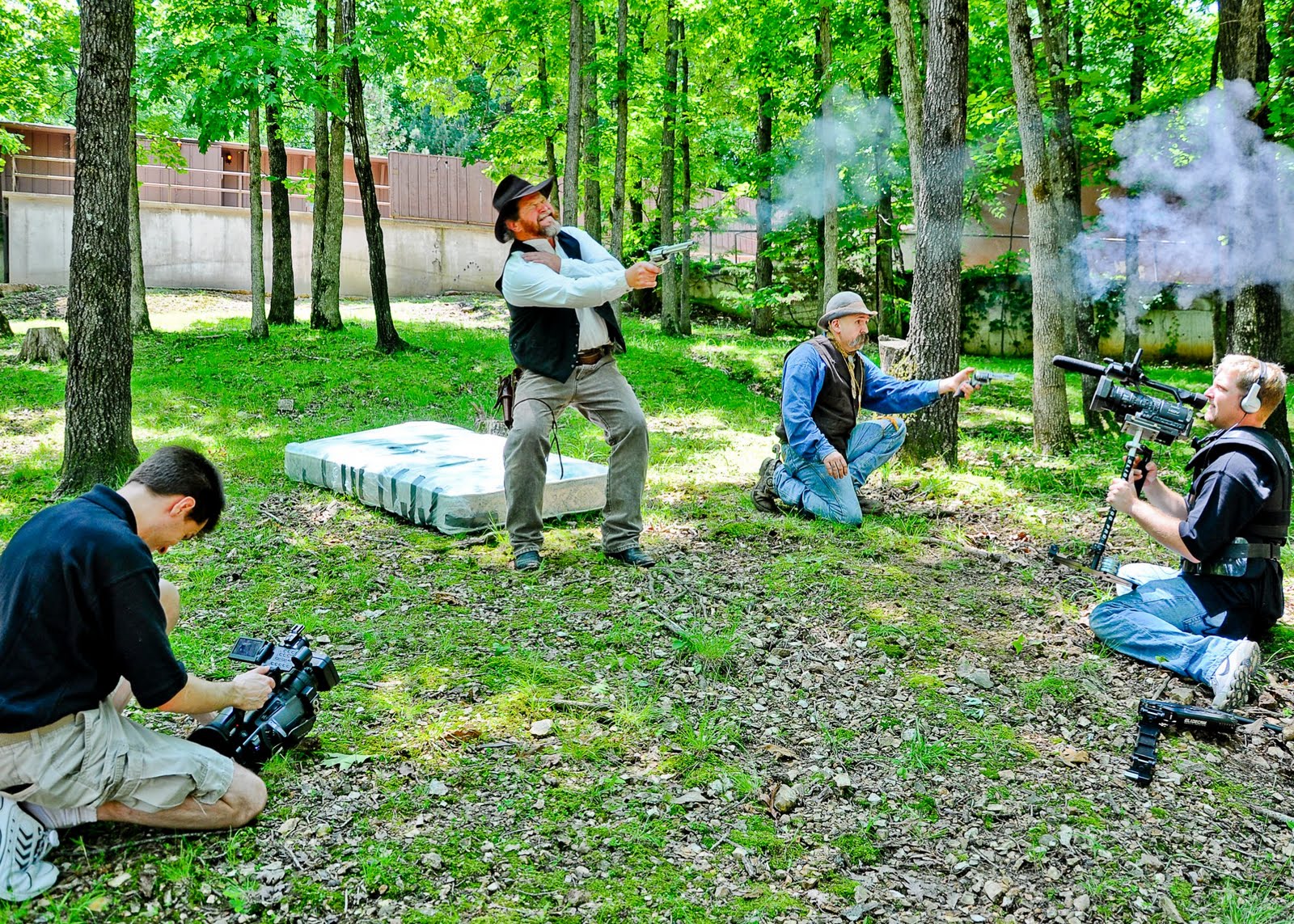


These are some more photos taken on the movie set of the "History of Branson". Have you picked up your copy yet? Many have and the reviews and replies that have been receive have been most positive. Mike Johnson talked to me and gave me an update to his new project preparations and the pieces are all starting to come together. I am so looking forward to this new project because unlike the the "History of Branson" project, I am getting the opportunity to work with it from the beginning instead of picking it up in the middle. Man what an honor to be included into the Bear Creek Production Team. These are a great bunch of guys and gals who love their work and are committed to the production of a great product.

Well with a little good fortune we are going to be able to set up a retail selling outlet within the next few weeks. We are zeroing in to a location and hope to finalize the are plans soon. Then you will have the opportunity to pickup some of our work without having to go through the ordering process and shipping time. And if all goes as I hope our prices for our pictures will be very reasonable in deed. And there will be more than just our pictures for sale, but you will have to wait for that added announcement.

This installment of Pro Pix Tips is going to continue with our discussion of composition but is just a bit off the trail. We are going to take a quick look at the use of flashes for our lighting needs. We have had some discussion about lighting in past post but I want to touch on something that came up in one of our venues were we are using multiple flashes for our photos.

Cameras with flash capability have what is called a "sync speed" which simply means that there is a maximum speed that the shutter can be set so that the flash will fully be able to light your subject so that is captured by the sensor properly exposed. If that speed is exceeded the lighting will appear to light your subject only partly. This will appear as a very distinct line where above it the photo will be properly lit while below the line the photo will be very much under exposed. This is due to the fact that the shutter is opening and closing so quick that the flash will not fire fast enough to expose the entire photo. On the other hand if a shutter is set to a speed less than the sync speed there will be very little difference in the lighting of your subject. This is because that for the most part the light from the flash does exactly what the name implies, it flashes at a high rate of speed. So if I am only counting on the flash as my light source it will make very little difference whether I use a shutter speed of 1/200th of a second or 1/10th of a second. The exposure of the photo will not be that much different. The ambient light being produced by any other light source will be different. Why? Because unlike the light from the flash, the other light source will be continually on throughout the exposure time. Therefore, the longer the shutter is open the brighter the ambient light will be in the photo, and visa versa. So how can you control the exposure of the photo with only a flash as the light source? With your ISO and aperture settings. ISO (International Organization of Standardization, so why isn't IOS) denotes the sensitivity of the digital sensor of the camera. The higher the ISO setting the more sensitive the sensor resulting in higher exposure, and visa versa. The aperture refers to how open or closed the lens is. The more open the lens setting the more light gets to the sensor and the brighter the exposure and visa versa. Only when combining the flash with ambient light will you be using different shutter speeds to control the light. The technique of how to do that will be discussed in a future PPTs.

I started writing this post on Friday and choose to finish it Saturday. While that seemed like a great idea at the time, sometimes life has a funny way of tossing in a monkey wrench or two into things. Today has been no exception. Personal notes are getting to be a habit for me. This one is most painful. I learned late Saturday evening that I have lost a very close and personal friend. The lose, though not that unexpected, has brought great pain and grief for me. I have known them for the majority of my life and having to continue without them will be very life changing for me. Life can be very cruel. It seems to get a kick out of dealing out cards in your life and watch you try to do something with them. None of us are immune from life's cruel acts. No matter what life gains from its' escapades, the one thing you can be assured of is the presents of shatters hopes, dreams, and lives that are left lying in its' wake. Because of my lose many of those aforementioned items have suffered that fate. No matter how many bowls of rusty nails you eat for breakfast, losses like this, no matter how they come, are always devastating. A part of me has been crushed by this lose, I fear to a point of no recovery. For those who truly know me, they know I don't take losing well. But as I stated at the beginning of this post there are still those things for which I am grateful, the times I shared with this friend among them. But it's the time in the future that life has stolen that generates the hurt and pain for which there is no relief. No matter how good the memories, how kind the thoughts conveyed, it's virtually impossible to be thankful when your heart is no longer in one piece. My friend is gone but my love for them will remain unchanged forever.

Richard

Monday, November 15, 2010

Moooooooooo!

Hello everyone! Welcome back. This time of the year is always hectic around here. Our souvenir division is busy keeping up with bus season and of course we do have our venue with a Santa Claus setting in front of a tree. Out of respect for our Santa, I will not post any photos.

Have you caught the commercial where it shows this guy standing in front of a photo on display that he had apparently taken. He is shown taking questions from what appears to be pro photographers and one of them ask if he would disclose what aperture setting he used for taking the photo. While holding his hands in front of him indicating a distance or size he replied, "A really big one." The announcer then says that this camera make taking great pictures easy. In others word, all you need to rival the pros is this camera. WOW! I didn't catch the manufacture and I'm praying it isn't Nikon because I really don't want to switch cameras but I might seriously consider it if it was them. The things that are done to make a buck with little consideration to the potential consequences.

To shift gears a bit, I have a friend that I have the opportunity to talk to quite frequently. He's been involved with a lady for quite awhile and have plans for the future. We have talked about those plans and this lady friend of his on numerous occasions and with full disclosure these plans involve many major changes in both their lives. He's always seemed up beat and happy about the relationship until the last time or two that we've spoken. He told me that he has met another lady who has been trying to steal him away and in his words "she's doing a pretty good job of it." He told me that in just the few weeks that he's known this lady, she has made him happier than he has been over the past two years with the other lady friend. While the stress and tension that comes with the plans they are discussing explains part of the bickering going on between them, it doesn't explain the difference in the levels of happiness he's feeling. No I'm not trying to turn this blog into a soap opera and I probably would have even bothered to bring it up if I hadn't ran across a different but similar situation. There's another gentleman I know who owns a business. Now while he has made some changes in his business operation there are certain aspects of his business which he tends to hold on to like a sacred cow. The fear of losing those things or at least the fear of lessening their importance to his operation grips onto him like a leech sucking the life from this guy. His friends have tried to talk to him and he does recognize the challenges that these thing present but even though he agrees with their arguments he still holds onto the belief that continuing to worship the sacred moo moo is the lesser of the evils. That is until the past few days. It seems that a knock has come to his proverbial door of opportunity. When he checked to see what was doing the knocking he found it to be an opportunity that he had not even seen coming let alone pursued. Now while his opportunity is in it's infancy it's still has provided enough encouragement to him to allow him to question just how truly sacred those moo moos really are after all. He said something that maybe we should all hear. Fear paralyzes us so much that we become blind to other options. Because of that blinding we allow things to control us to the extent we loose our own identity and self worth. As a result we feed the fear and the vicious cycle continues. It's an observation that I think has some merit. We tend to want to stay in our comfort zones no matter how uncomfortable it is. Why? Because while it may be uncomfortable it still is familiar and we don't like the unknown. Therefore, even though it may not be in our own best interest, we pour all of our efforts into maintaining those moo moos with our blinders on and our knees knocking. The problem is that while we pursue this course of action life is slipping away and opportunities are being missed. Not just in business but in our personnel lives as well. In a way we are making investments in our future. The problem is what kind of investments are we making? Are they those which lead us to a sense of accomplishment and satisfaction or regret and remorse? These are not easy situations and many times the situations seem either so crystal clear or so trivial that we fail to see how truly important and the lone lasting effects they potentially have on our lives not only now but for years to come. Since they are not easy and the majority of the populous love easy, people will generally allow what is easiest to govern their response and many times that turns out to be a huge mistake. Generally by the time we discover how big of a mistake it truly is, we cannot do much if anything to fix it. In some cases a higher power intervenes in spite of our fears and give light so we can more clearly see our moo moos as well as other courses that offers an even better life. But we can't always count on having things dropped into our laps (unless you are our Santa Claus. That's a private joke.). Most of the time opportunities are pretty stealthy and to see them you can't have your eyes on the moo moos. Don't miss out on the lobster because you're to busy putting pickles on the burger.

Pro Pix Tips. Well we are going to quickly finish up this part of our GOBO discussion. We will continue to talk about GOBOs throughout our look at composition but for right now it is important that we introduce the more common ones and briefly describe each one. We've already talked a bit about cookie GOBOs and you can go back and read that post.

FLAG GOBOs are used to block light from spilling over into areas you don't want them ie. the background area or back onto you camera producing lens flares or light reflections on the lens. They are generally black in color and can be made of any material as long as it does not let light shine through it. Most arencommonly made of cloth, poster board, and foam core.

REFLECTOR GOBOs are used to redirect the light coming from a light source to an area of the subject which needs additional lighting but you don't want to add an additional light source. An example would be where a reflector would be used while taking a photo outside one a sunny day where the reflector would reflect some of the sunlight back onto the subject to reduce the dark shadow areas on your subjects face such as the area around the eyes to better illuminate them. Cloth, poster board, and foam core are the most common materials used to make reflectors. The colors can vary but the most common are white, which tends to give off a cool white or flash color light, silver, which tends to give off a cool white or flash color but with greater intensity, and gold, which tends to give off a warmer yellowish color. Which one you use depends of the the feeling or purpose of the photo. The difference in intensity between the light coming from the source to the subject and that coming from the reflector varies based upon the distance between the light source, reflector, and subject but a good rule of thumb is 1 to 2 f-stops.

SCRIM GOBOs are used to soften light coming from a light source by effectively changing a small light source like the sun into a much larger light source. I know, the sun is a very big thing but while it is very big and bright it still very far away and actually look more light a spot light in the sky. As a result the light from the sun (a hard light source due to it relatively small size) produces a very distinct and dark shadow. When we place a scrim gobo between the light source (in this case the sun) and the subject of our photo, the scrim actually becomes the light source because the light is passing through the whole surface area of the scrim in affect becoming a much bigger light source (depending on the size of the scrim) producing a more soft light onto our subject with much softer and less distinct shadow areas. Depending on the material the scrim is made of, a rule of thumb you can use to judge how much lower the intensity of the light will be from no scrim vs. scrim is about 2 f-stops. Cloth or silk material are mainly used with white the usual color, but don't be surprised if you see a golden colored one.

GOBOs play a very important role in our shaping of light when we use that light to capture our images. As we continue our exploring of composition we will us GOBOs a lot.

Now on a more personal note. One of my staff members and very close personal friend lost their mother late Monday evening. I have known Monty for well over 40 years. She was a good women even though we had our disagreements from time to time. She was funny, kind, and loved her children more than life its self. She cared about those around her, family or not, and was always quick to help others whenever she could. From what I know of her past, life was not always kind to her but that didn't seem to dampen her happiness and outlook on life. Over the past years she was troubled by some persistent medical issues but despite the pain and difficulties those issues produced, she never allowed them to get her down or stop her from doing what she wanted. If one was to look at all she had had happen to her, a strong case could be make that life just wasn't very fair at all with her. I personally can say I never her Monty complain about any of that. She was always quick to comfort others even when her own issues were affecting her worse. Her children were her life and she was constantly concerned about their lives, especially her grand children. But in recent years life smiled on Monty. Additions to her family came in the form of her beloved cat and a man who I believe she loved with all of her heart. Their relationship brought her the happiness and joy that I feel had been missing for most of her life. I believe in my opinion that happiest times of her life came in these last 5 or so years. It's true that I wasn't that aware of all that was going on in her life but I do know that she seamed genuinely content and happier. Life is really crazy. With all the medical issues she fought with all those years, it was a fall that took her from us. Even though her passing did not come as a surprise and one can easily make the case that she is with God, free of pain and all those issues that for so long assaulted her, our pain and sorrow of being without her presents is real and will remain with us. For us who knew her and profess our faith in Christ, we will see this wonderful women again because she knew Christ as her Saviour. And when you compare the length of eternity, our time separated from her will be short, but that doesn't lessen the sorrow and grief of our time now. I loved Monty and called her mom. My love and prayers are with her family especially for Jackie. Jackie has many of her moms wonderful traits and for that I am truly grateful to Monty. I will miss her.

Richard

Thursday, October 7, 2010

Have My Point. Now What?

Hello everyone! Thanks for checking out the post today. As you know, we are taking a look at the wonderful world of composition in a series of Pro Pix Tips and today we are going to start looking at the second step of composing that photograph you want to take. But before we get started I'd like to catch you up on some previously mentioned projects we are working on.

I told you about a mobile production unit we are putting together. We had to bring this vehicle in from way out West and that was not a fun task but we got it back here into town by the grace of God. But that's just about how far we have gotten on it. It will need a lot of cleaning up before we can start working on it to make the changes we need to make it useful. We hope to have that task done by the end of the week. She's a beauty and I can't wait to get it operational. When completed, we will have a vehicle that can handle virtually any on site location event to include weddings, engagement and senior shoots, church directory shoots, party and special event shoot, and on the list goes. We will be able to have power for our light systems and an area for our models and customers to change without being potentially exposed. We will have the ability to carry virtually any equipment we need in order to get the results we want and the model(s)/customer(s) will be able to view their photos on a full size screen and see how they look while quick and basic editing is done right there on the spot. And when it is hot there will be a cool place for those on the shoot to keep their cool with water and soft drinks available. We'll keep you updated from time to time as we make further progress.

The History of Branson movie is still being edited. I had a call from Mike Johnson who owns Bear Creek Production and is the director/producer of this documentary movie and was given an update on the progress of the video. Production has been interrupted several times due to layout changes and conflicting projects that had to be address but still a lot of progress is being made and when we have a release date I will let you all know.

Pro Pix Tips: Let's get out the old can opener and begin digging into this next part of composition. In our last post I said that the very first step to good composition was having a reason to take the picture. I also said that every picture tells a story and the trick is to ensure that the story it tells is the one you intended to tell. Therefore answering the question, "Why" brings us to the next step in composing our photo, "How?"

"How" is not as simple as many self proclaimed photographers might have you to believe. It has several factors that will determine how you take the shot. In fact, contrary to popular belief, virtually every "How?" is not limited to one shot. In fact, a whole series of shots should be made to capture the photograph as your minds eye envisions it. One way that generally tips you off about how good and experienced the photographer is is to watch how many different adjustment and angles he or she makes when setting up their shot (I'm throwing that little tidbit in for free). Even the most seasoned pro takes a lot of pictures in order to get just the right look they're looking for. To get just the right look for that one photograph that the pro releases, they may take a staggering number of shots all with little to hug changes in setting and positioning. The thing that determines what the right look is will be determined by what story you're trying to tell. It also determines where you will take the photograph, either on location or in a studio setting. While we will discuss the "Where" question in a future post, I bring it up now because the location has a deep impact on "how" you're going to set up your lighting for the shot. Usually, how we capture the ambient (natural or existing) light greatly impacts the composition of the photo. If our subject is located in a shady area with a sun lit background how will you balance the lighting in the shot? Is the shade producing any splotches of sunlight onto your subject giving them a kind of lighted bullet hole effect? Will you need any kind of light shaping tool such as a scrim, reflector, flag, or even a cookie to control the light and contrast of the shot? Have I just started talking Greek to you with some of those terms. If so, than depth of field, white balance, key and fill lighting, as well as noddle points may be equally unfamiliar to you. Not to worry. We will touch on these and much more in future post.

As I said at the beginning of this post, "how" is not as easy as some people make it out to be. What determines that is whether or not you want to settle on the just "good enough" band wagon or rather take the time and effort to apply some effort to get the right shot that captures fully what the minds' eye sees. Decide not to be a GETGB (pronounced "get-geeb") which naturally stands for "good enough to get by" person. Commit to taking some pride in each and every shot you take by going the extra effort to get the shot right.

We'll continue with "How?" in our next PPT by looking at the different ways to light our photograph. Have a great day everybody!

Richard

Tuesday, October 5, 2010

What's The Point?

Hi, everybody. The season here is really at a contradictory time of year. On the one hand, tour buses are on the increase with each passing week. On the other hand, Christmas is right around the corner. I'm only about 7 weeks from my traditional viewing of the movie "A Christmas Carol" starring George C. (Patton) Scott. I just love that show. In fact, I just love the story no matter which version is showing but I like the afore mentioned one the best. And while I love the Holiday part of the year it's still the end of the year and business from the tourism side drops to zero and we have to lay off our employees. It's also that time of the year where we really have to honestly look at where we are and compare that with where we hoped we would be and sometimes that isn't a pretty thing to do. You always have to evaluate how the business is doing and see where improvements can be made. Sometimes, changes are easy to recognize and other times it's like Snipe hunting (for you long time hillbilly folks you will know what Snipe hunting is, for the rest as an old timer). Either, way it always makes for a bit of stress and sometimes a few sleepless nights but much like beating yourself with a hammer it always feels so good when you get done.

I continue to be amazed at the amount of revelations that keep coming which have been prompted by the "trilogy" post about service station attendants. I have taken a little extra time during the course of the day to surf the net looking for articles that have some connection with those ideas that were proposed in those blogs. And boy are they out there. I read one which was openly encouraging folks to sell their photos online telling them that there was a lot of demand for photos of all kind and it didn't matter how much knowledge or experience you had or how good a camera you own, just take the pictures and post them for sale on line. Don't worry cause I'm not going to take off down that road today. However, it has encouraged me to continue exploring done the path I talked about in those blogs. I have me ideas and I will keep you posted on them. But for today let's continue our discussion on composition with todays Pro Pix Tips.

If you have kids then you will understand the thought I have about the most favorite word in a small child's vocabulary is the word "why". Why is one of those words that can be as annoying and frustrating as it is exciting and necessary. Recently, the word "why" is loosing its' popularity as more and more people don't care why, just that something is or does. But there are those times that "why" just needs to have an answer. Anyone who will admit to knowing me will tell you that on more than one occasion they have heard me say that every picture tells a story whether you thing it does or not. The old saying that a picture is worth a thousand word is quite correct. Have you ever found a photo that was taken many years ago and when you looked at it you had no clue where it was taken or who those people are standing around you. The story has completely changed from the intent of what the photographer was wanting to tell. What the story is telling now is that the photographer did not take "why" into account when they were composing the shot there by failing to capture the memory that was intended. Sometimes we capture a memorable event but, because the composing of the picture was done without insuring that the "why" is properly captures, the story the picture tells can be quite different from the intent. An example can come from out souvenir trade that we do inside area restaurants. We tell our folks to get the guest to set next to each other and have the male put his arm around the lady he's with. The story here is of two people who care about each other and enjoying their time together. But on several occasions our folks can't or won't get the couple to set next to each other and take the picture with the table of food piled high on there plates between them. The story here is (especially if either one or both are over weight) these folks are fat and here's the reason why. "Why am I taking this photo?" is the first question you ask yourself when you begin compose your photo. It's hard to know when you get to where you're going if you don't have a destination in mind. If there's no reason for the picture than what's the point of taking it? It's only when you have a point to the photo, a story to tell, that you can press on to the rest of the composition techniques. "Why" identifies the subject of the photo. Only then can you begin to position the subject of the photo in such a way that the future views of the photo will easily be able to identify. In doing so, that all import first step is made to lead the viewer to the rest of the story (sorry Paul, but the phrase fit so well here). If the "why" and thereby the subject of the photo is not established then no matter what you do to compose the rest of the shot will matter.

One last thing that I would like to add before tying a bow on this post for the day. It's about the old "kiss" thing, Keep Image Subject Simple. OK that may have been a shameless act of acronym stealing but it still works as the Keep It Simple Stupid thing. A major problem in the composing process is that some folks try to capture the entire book of "Gone with the wind" in one photo thereby trying to make a picture worth a million words with very few of them making any sense at all. "Busy" photos are not very appealing at best and extremely confusing at worst. There are several techniques that can be used to accomplish this, but they all start with the question "Why?". Otherwise the photo you take may be met with another question you as the photographer never want to hear asked of your work, "What's the point?".

Well, we're off like a herd of turtles with our discussion of composition. Tune in next time when we'll hear our hero say, "How?". Have a great day everyone!

Richard

Tuesday, September 14, 2010

TOP SECRET: Bracketing

Hi everyone! I have been taking some pictures over the past few days and some of the views that I have gotten the chance to see have been beautiful. The weather has been pleasant and mostly sunny. I have been out shooting with very limited equipment, for the most part just a camera and one lens. While the photos have turned out good I have had to pretend that I'm shooting a film camera because I also do not have my loop which is a fancy name for a eye piece that blocks out the sun so you can get a very good look at the camera's LCD. Without it getting a reliable idea of how the picture looks is difficult if not impossible. So I thought we could do a Pro Pix Tips covering this very issue.

Pro Pix Tips: One of the many great benefits of the digital cameras vs. the film cameras is the opportunity to view the picture instantly instead of sending the film off for development with the hope you got the shot. The pros had to have the shot every time, that's why they got the big bucks. In order to accomplish this the pros developed a technique called "bracketing". They would take a picture at the setting indicated by the light meter. Then they would take several additional pictures above and below the indicated exposure readings. The number of pictures above and below that the photographer would take was a personal preference. In doing this the photographer would be able to get some measure of insurance of make sure they had the shot. The exposures that were taken added to the cost due to the film used and the development cost.

Today, pros still use this technique even though they can view the picture instantly. Why? Well that is a very good question. Sometimes it's because the photographer doesn't have a view screen loop in order to see the screen in the sun light. Now let me quickly throw in this at no extra charge. Be careful to have your meter setting, spot, center weighted, or matrix/dynamic, cause that can effect the exposure of the subject of the photo (go ahead and ask how I know). Other reasons include that sometimes photos look better a little under or over exposed and you won't get that picture if you hadn't taken it. Sometimes the effects that are caused by the change in settings are quite interesting and give a special contrast to the photo. And one additional issue is that the photo doesn't always give an exact look due to the settings of the LCD.

So what do you do to use this bracketing technique? In the film days it was the shutter speed that was generally used by increasing or decreasing shutter setting. With the digital cameras there are several ways to do this and I would suggest in refer to your manual but in many cameras there is a exposure compensation setting that can be used to increase/decrease the aperture in small increments. There is even in many camera a bracketing setting were you can set the camera to automatically change the settings in a systematic way so you don't have to manually change the setting taking up time.

But bracketing doesn't end there. Many of todays digital cameras will also bracket the white balance settings and flash units. With the white balance settings (we will have to have a PPTs on this subject at a later time) the warmth and coolness of the picture can change the whole feeling of the photo adding to it's softness or dramatics. For flash units the power setting is changed to control the brightness of the flash with similar effects produced by changing the aperture settings.

Bracketing is an old technique that hasn't been out dated due to the digital revolution. With the technological advancements bracketing has been improved and become an even more important secret weapon for the pro photographer. Without the bracketing technique you are losing a lot of great photos. Try this out for yourself. Go take a photo of something and then try changing the shutter speed, aperture, and yes even the ISO setting and check out the result. Take bracketing and put it into your photographers tool box and use it to help improve the quality of your pictures. I've said before that taking lots of picture is one of the chief pro top secrets and now you'll need to take even more due to bracketing.

Well that's it today but before I close I would like to do something that I've done before but is worthy of repeating. No one is an island. Behind every good company is several crazy but great employees and I have a few of those. I would like to give a big thank you to two of them for handling a situation they are not hired to do. Jackie and Chris are both outstanding workers (even though I could shut them from time to time) and have stepped up to the plate in order to handle some unexpected problems and handled them like champs. Thanks Guys!

Have a great day everyone!

Richard

Monday, August 9, 2010

Don't Miss the Shot!

Hi everyone! Lots of things going on, so much so that I think I keep passing myself on the road. I'm really mad at me because when I do pass myself on the streets I always wave but being the kind of guy I am I don't wave back and that just makes me so mad.

Seriously, there are a lot of things a happenin' around here. While I haven't seen the article yet, I am told that there should be an article in the upcoming addition of the Missouri Life magazine that will be discussing the new "Shrine to the Holy Spirit" and the wedding chapel that is located there in. I am told there should be several pictures in the article taken by yours truly. I'm also told that there will soon be fliers placed around town and the surrounding area advertising the new services being offered there. We are very pleased to be associated with this new Mansion venture and look forward to helping to create the perfect wedding day for all those who choose this wonderful location to celebrate the love they have found and their commitment to each other. If you are thinking about getting married and are looking for a place to have your ceremony I would encourage you to check out the services being offered through the Mansion at this wonderful location. Tell Tina that I sent you! Hopefully she would charge you double just for knowing me.

Also, the new "History of Branson" movie is going into its' final production time and I expect that it will be finished and release to the public in the next few months. I do know that Mike at Bear Creek Production has a few one on one interviews to record including me I'm told but that should not take very long at all. I will keep you posted!

Pro Pix Tips: I have had the opportunity to talk to a couple of folks the past few weeks about photography and during each of those conversations it seems that I wound up talking about the same thing. It usually starts out the same way as well. I'm thinking about getting a camera and wonder if I should get a Canon or a Nikon. What model should I get? What lens should I get? Folks, don't get me wrong, next to taking pictures I like talking about photography and taking pictures. But there really isn't a good answer to any of those questions. Now I shoot a Nikon and so my usual answer to what kind of camera to get is "The only people who shoot Canons can't spell Nikon!" That's the partiality talking. In fact, the only true answer is "That depends" on what type of photography you want to do. Camera's for the most part have a lot to do with the degree of comfort you have in using it. I'm not saying that there isn't a difference between the two because there are many, but how comfortable you are with the use of the camera plays a huge role. Both companies put out great products with great accessories to go along with them which also have a role in the consideration of which camera to buy. The thing is that it doesn't matter how good a camera you have if you don't have some good knowledge to go along with it.

With that in mind I would like to touch on something I haven't talked about much if any before this. You have to be continuously look for opportunities to get a great picture. Don't ever let your guard down because you just might miss a great opportunity. Case in point is I was driving though a parking lot the other night around 11:30 pm when I saw several things that looked at first like small branches of a plant or bush. After passing the 5th or 6th one I decided to stop and check it out since it had not been storming or any strong winds. What I found was not a stick or small leafy twig. What I found is below.


I had to give $5 to this Praying Mantis to pose for me (hey, times are tough everywhere) and getting a signed release was another trick in and of itself.

Seriously, I could have just missed this picture if I hadn't been alert or didn't have my camera with me and there have been many times I have done just that. You can't get the shot if you don't see it in the first place. In short, while what kind of camera to buy is important, don't forget to train your mind and your eyes to seeing the things you can capture with that great camera (that would be a Nikon I'm sure) you finally do purchase. Don't forget the WWATT thing (What Wound A Tourist Take) and avoid waisting your time on those shots. And just don't settle on taking just one picture. Take lots of shots from many angles. That's what I did here on this picture and I think the results look great. So keep your head in the game and keep shooting those pictures. Send them to us, we would love to see your work.

Well, that all for me today gang. Have a great day!

Richard

Thursday, July 15, 2010

Adventures with Chris the graphics guy!

Hi everyone! Busy, busy! We have been vary active with new work projects and a few just opportunity shoots involving several widely known entertainers. It's kind of wild when you have the opportunity to photograph several well know stars in the same picture, print them and put them in photo sleeves, give them to each of the stars and then set back as they look at your pictures of them and then take turns autographing each others photos. While I can't use names I can say that one of them tends to fly around the stage a lot during their performance and several others dress funny but collectively sing real pretty.

We are still waiting on the completion of the "History of Branson" movie. Mike from Bear Creek Production tells me that the editing is coming right along and I plan to visit their production facility in the next few days. I have always found video production fascinating and Mike has been kind enough to allow me the opportunity to come by and annoy him. I am looking forward to that visit.

I have in the past talked about the guys who work for and with me. Jackie has been working on her photo skills and during a recent post wedding shoot and the impromptu star shoot she captured some great shots. She also was the backup for a wedding we shoot and those turned out great as well. Chris our graphics guy got an opportunity to do the old on location assistant thing the other day. It was a tad windy to say the least. Now in order to appreciate the rest of this story it would be appropriate for me to have another Pro Pix Tips inserted here and then give you the rest of the story.

Pro Pix Tips: I'd like to remind you that photography is all about how you control and capture the light. Sometimes we need only use position to get the light to be our friend and illuminate our subject as we need. Other times the light causes too harsh of light (commonly referred to as a hard light source) which produces to heavy of a shadow area on our subject or will be at such an angle as to cause a deep shadow around the subjects eyes commonly referred to as Raccoon eyes. There are several different kinds of tools we as photographers use to control the light and they all have funny little names. Anything that is placed between the subject and a light source whether it be a flash/strobe, room or spot lights, or the sun itself is called a GOBO. Some GOBOs are designed to prevent the light from illuminating part of the area you want to photograph. These are called "flags" and are usually black in color to help prevent any unwanted reflections of the light. Others are designed to allow light to pass through them thereby softening the light so as to reduce the harsh shadows. These are called "scrims" and are usually white in color so as to not project an unwanted color onto your subject. The ones we use are home made out of a light weight frame and a white bed sheet. The size depends on how big of area your trying to cover or illuminate. The bigger the scrim the softer the light because the scrim when placed between the subject and the light source actually becomes the light source and generally increase the overall size of the light source (yes the sun is very big but at the distance we are from it, while very bright, is still is a relative small dot in the sky). Depending on the area it covers the scrim cause the light to spread out over the entire surface of the scrim and then over the subject allowing the light to more readily wrap around the subject and reducing the hardness of the shadows caused by a small light source like the small dot sun in the sky. This allows your pictures to have softer contrast to your subject and give a nicer more three D effect for your pictures. Try it out for your self. Find a toy or another none flat subject to photograph. To light up light your subject us a strong flashlight pointed directly at your subject. Note the hard shadows caused by the small light source. It's small light sources that cause hard light. Now find a small sheet to place between the subject and the light source (flashlight). Make sure that the flashlight is back about three or four feet from the sheet. Note how much softer or less harsh the shadows are and how much more of the subject is illuminated. Just remember that any time you place something like a scrim between your subject and light source the strength of the light is diminished and so you will need to move your light source closer or adjust the shutter speed and lens opening to accommodate for the light reduction. Play with that and see if it doesn't make your pictures look a lot better especially those taken outside.

Now to continue my story about the adventures with Chris the graphics guy. Chris was holding one of our scrims up and over the heads of our bride and groom placing great light onto our subjects. Now there is one small detail that I left out of the Tips. If you will remember what they are made of you might notice a similarity to a sail on a ship. Please recall it was a windy day. While I'm looking through my view finder, one of the many things I don't want to see is any part of that scrim so it and Chris our out of my view. Just as I am about to take my picture I hear Chris start saying "Oh! Oh! Oh!". Then I hear Jackie yell for Chris to hold on as she runs in front of me and my camera toward Chris. It's only then I realize that the wind has caught the scrim and is wiping it around coming very close to hitting my bride and groom who was looking at the camera and unaware of the events unfolding inches from their heads. With the help of Jackie the scrim was brought back under control and we were able to complete the shoot without any more incidents and the bride and groom alive to tell the tail. And to think my mom wanted me to be a brain surgeon. Where I ask you is the adventure in that?

Got to run guys. Have a great day everyone!

Richard

Monday, May 24, 2010

It works in the movie!

Hi everyone! Welcome back to our blog. Have you ever wondered where the name blog came from? I am sure it makes sense to someone but I guess I have missed it. Well something we don't want to miss is the Pro Pix Tips I promised last time we met. Let's get to it.

Pro Pix Tips: Picture composition is a major part of a photography that separate casual photographers from the more advanced photographers (how's that for a little diplomacy). One of the most basic rules of composition is called "the rule of thirds". Now I could go into a great deal of rambling but instead let's just cut to the heart of the matter. Positioning the subject of your picture is tied to what is appealing to the human eye. Rarely does the placing of your subject look the best or most appealing to the eye when the subject is place directly in the center of the shot. So how do we get the picture to be more eye appealing? It starts with tic-tac-toe. Take a piece of paper and draw a tic-tac-toe playing board. Now draw a box around the playing board to represent the view finder of your camera. Note how the view finder is divided into thirds horizontally and thirds vertically. Where any horizontal line crosses a vertical line that is a point where a subject can be placed in the picture and be a more appealing placement to the human eye. Any point of interest can be placed at any of these points and will fit in the rule of thirds for picture composition. One additional point here is if the point of interest is a living thing that has the ability to look at or face something. These should face into the picture and not out of them. If they are looking out of the picture the viewer of the picture will be left with a sense of question or confusion as they wonder what the subject of the picture is looking at. Now as with all rules they do have exceptions and when to use those exceptions is why there is still a need for professional photographers (how's that for a not so subtle comparison).

Now, to help you with with this rule of thirds and the tic-tac-toe board thing many of the new cameras have a display option that will place a tic-tac-toe grid on the view finder itself. Play with this rule of thirds and try to take a picture of someone or something placing it in each of the 4 crossing points and the middle of the picture as well as your subject looking alternately in an out of the picture at each of those point and study each of them your self. Then show them to someone else and get their opinion. If you do I am sure your composition will improve greatly. Try it, you'll like it.

Now on to the rest of the blog (blog? How did they settle on that?). The title might be a little thought provoking at first and maybe you've already guessed what it's all about. On Sunday we were on location of one of many movie sets of the documentary film of the "History of Branson". Our friends at Bear Creek Video Productions are doing the film and I'm telling you they have gone to great lengths to research the facts and capturing those facts on film. BCV Production owner, Mike Johnson and his entire staff are great to work with and present a professional work ethic that made the entire movie set relaxed and easy to do the job. And not to be left out, the actors and technical director are all classy people who love their work and, like the BCVP staffs' work ethic, professionalism was clearly in their blood. It's one thing to do a good job because you're paid to do it, yet another because it's a passion and clearly that was not lacking in any of the crews. The only negative encounter I had involved a ground hog and maybe I will share that incident in a future post if someone reminds me.

This is a great film and has so much information about the Branson area that I had no idea was a part of this local history. It's been a project in the works for years as I understand it and the research behind it has been exhausting. Some of the stories have been filmed on the location where they took place and some of them are a little difficult to find I'm told. But found they where and I for one am looking forward to its release sometime later this year. Our excitement has nothing to do with the fact that some of our photos are going to find their way into the final project........really nothing to do with that. Over the upcoming weeks I am hoping that we will be able to share some of these photos with you when we have the release to do so. I do know that Mike got video of us taking photos while on the set and will being getting some of that video to us for display on this website. I'm looking forward to that as well, not because I'm on it.....really not especially sense I'm on it....really!

Now I want everyone of you to mark down on your "to do" list to watch for the release of this great documentary movie "History of Branson" and buy one for yourself and everyone you know! They plan to have the movie distributed nationally and I'm sure we will have links to where you can find them. You can bet we will scream the news about the grand release here and I'm sure we will have several more entries to post in the future about our further adventures with this film in this blog (blog? Where, how, ......oh well).

Have a great day everyone! Richard

Sunday, May 9, 2010

So your getting married and need photos.....

Hi everyone! In this blog I thought I would get a little deeper into what I was taking about in the Grand Opening post. In doing so, I wanted to concentrate mainly on the wedding photo part of why getting a professional photographer just might be a better idea than a relative, friend, or friend of a friend, etc. But before doing that I thought I would do a another first here for this blog and give my very first camera and picture taking tip. Now how cool is that!?

Pro Pix Tips: As some of you might have noticed, I am a religious kinda guy. And I'm sure that whether you are or not you remember as I do the WWJD (What Would Jesus Do) thing that was so popular a while back and I guess still is to some degree. Well, for this our first ever Pro Pix Tips (isn't it so exciting?) I want to have my own WW thing. Let's first start by having a question: "What's a good picture to take?" There are so many things that go into what makes a good picture and over time I will hit on several of them. But there is a fundamental, down and dirty starting point that you should consider before you take a picture. It's something that you should do after you decide what you're going to take a picture of. For example, lets say that you are at a park and you want to take a picture of a flower. Before you point your camera at anything, you need to find some place were you can set down where you can see the flower you want to take a picture of. Sooner or later some tourist is going to see that same flower and take it's picture. Then another tourist will do the same thing. Take note of the angle and positioning of the tourist pictures being taken. Why? Because that is the pictures you don't want to take. Why? Because it is these pictures that are repeated over and over again. They're usually the normal garden variety common shots that are taken. For your pictures to be good they need to be different or unique. Taking a picture of a flower from a position where you have just walked up to it is boring and the way everyone looks at the flower. Find a different view or angle from which to take that picture. Seeing things from a different perspective is a fundamental key in planning a shot. As an exercise try taking a picture of a common item, a park bench, picnic table, trash can, or any thing that normally wouldn't be that interesting as a "common" picture. Look for ways (more than one) to find a different angle, view, and position to get the shot. The object is to add interest to a subject that doesn't have much on it's own. How many different shot can you get? I believe you'll be surprised. Oh, so what about the WW thing. Well, one of the questions you should ask yourself before you take your picture should be WWATT, What Would A Tourist Take? DON'T TAKE THAT ONE! It would be a Cardinal Sin!
(Don't you just feel all getty inside?)

Ok, now for the rest of the post. Back in the pre-digital days, hiring a professional photographer seemed to be more of a necessity than it does now a days. It wasn't as seemingly goof proof as it appears now with digital. The equipment and knowledge level seemed out of reach for most folks. It was tricky at best to make sure you got the picture right sense you couldn't be sure until the film was developed. And then there was the expense and time involved. $500 to over $1000 just to have the proofs developed not to mention the editing of the proofs and the reprinting of those proofs with color corrections, well, cheep it was not. It was somehow a bit more understandable why wedding photos cost so much. Then came the digital age. Once the cost of a digital camera reached a level where it was affordable and people where able to set them on "A" for automatic or "P" for professional (that's not what it stands for by the way) things began to take a bit of a change. Part of the change came from the pros themselves. Even though their expenses decrease many didn't lower their pricing because the cost of software and computers and the time and expense the pros felt they were adding offset what they were saving on film development. True or not the problem quickly became that those non pros were able to take a "good" picture with their "good" camera and put them on a disk so they could be printed at some inexpensive photo center. Remember the old saying that if something sounds to good to be true it probably isn't true? Well in reality someone can take pictures at your wedding and give you a disk and charge you far less than what most pros charge. If that was the whole story than that would be a unhappy ending of the pro but it's not. To start with you might take this opportunity to reread the PPT at the top of this post. Than is there going to be any editing. How about quality lighting. How about catching the majority of the event. Most of the weekend photographers I have heard about only take enough pictures to mostly fill a disk and how many of them are usable and quality of the contents? How many pictures where missed? The problem is that you have nothing else to compare those pictures too. I recently talked to a person who has taken wedding pictures and senior pictures for a few years now. They had actually had to fly across county to do one wedding. As we talked it became quite clear that this person knew very little when it came down to photography. Basic camera functions seemed vary removed from them. Yet there were those out there who where having some of the most important picture in their lives taken by someone who didn't understand much about photography in my view but I'm told they have "a good eye" for it. And if that's not enough evidence for you then let me add this. This individual was taking the few pictures they were taking (the good, bad, and ugly ones) and putting them on a common disk they purchased at a office supply type store and gave it to their customer. Why is that bad? Because most experts say that the pictures stored on those common types of disk could fail to maintain those images in a usable state after a short number of years. To be sure that those images maintain there viability they should be placed on disk designed for long storage. Anything else could allow you to loose the only images of your special event allowing for your memories to be at risk as well.

All of this is a lot like bowling. The object is to roll a ball down a lane and knock over all 10 pins for a strike. While pros don't score a perfect game of 300 all the time they do get a lot of strikes. Now it's not uncommon to find someone who has never bowled a day in their live, take them bowling and have them at some point knock all the pins down for a strike at least once. But just because they did what a pro did by knocking all the pins down with one throw doesn't make them ready for the Pro Bowlers Tour.

I could go on and on but I've already been that this for a week now. I'm not trying to bad mouth anyone. My point here is to try to inform you that taking pictures isn't as easy as it looks. There is more to it than pushing a button and the focus be good. As I said in the first post, who would you want operating on you? A trained and skilled doctor who does this work every day and makes their living at it, or someone else who normally works another profession and does this as a hobby on the weekend after reading a book or two about it and has a sharp knife and a big bandage? Remember, a memory is a terrible thing to waste. Don't gamble with more than you can afford to loose! If it's important enough to do, it's important enough to be remembered.

Have a great day everyone! Richard